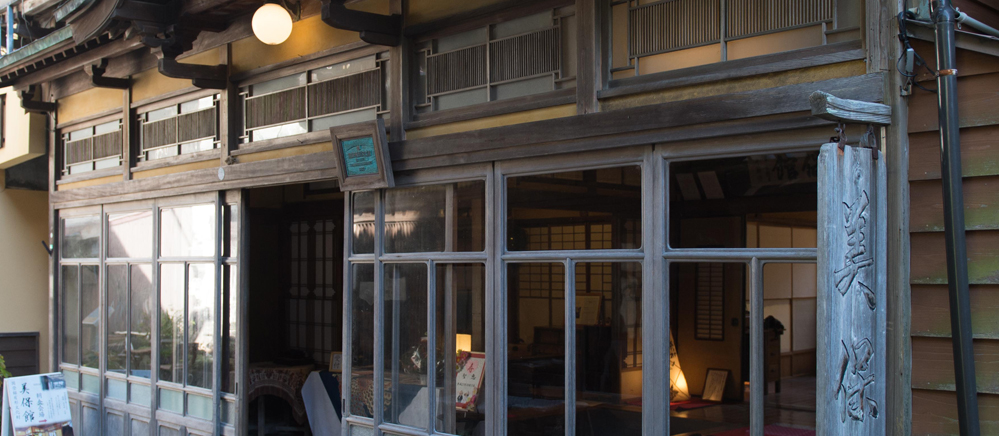
In the Muromachi period, the family oversaw commerce in Mihonoseki in the Japan-Korea trade, served for generations as village headmen and elders, and used the trade name "Azuma." That site remains today as "Kotokan," the birthplace of the Sadahide family.
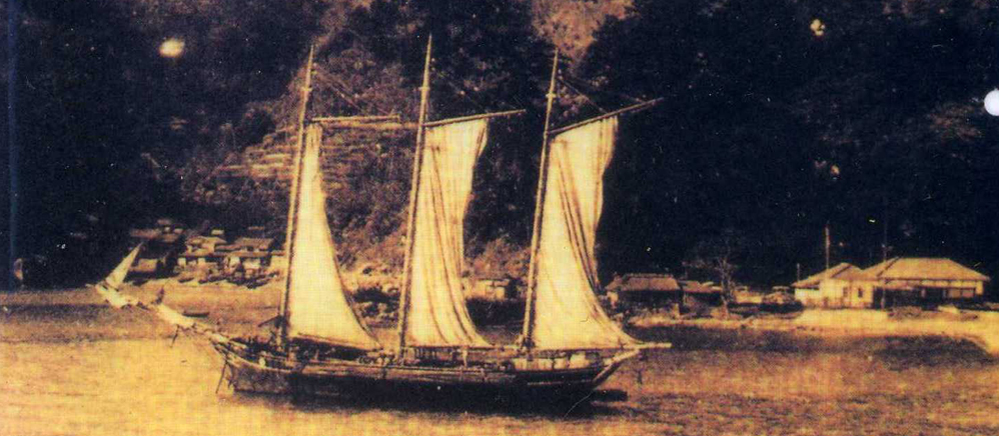
In the Edo period, Mihonoseki bustled with Kitamaebune ships calling from thirty-three provinces. Among the merchants, "Azuma" monopolized trade with the seven northern provinces (Dewa, Sado, Echigo, Etchu, Kaga, Noto, and Echizen), which boasted the largest trade volume in the shipping industry, as well as the Goto ships of Yonago and the Shinji ships of Matsue, and changed its trade name to "Kitaguniya." (The Kotokan site is the former grounds of Kitaguniya, where whaling tools and a natural cave used to store goods still remain.)
From the Genroku to the Hoei eras (early 17th century), Sadahide Ichiroemon, the 18th head of Kitaguniya, also made his residence in what is now the north wing of the Main Building and ran a business under the trade name "Izumiya (Izumi-ya)," dealing mainly with shipping merchants from the Senshu region. Izumiya (Izumi-ya) was named among the investors when the exchange office was established, and was a merchant house closely tied to the Matsue Domain. Through Kitaguniya and Izumiya, the family controlled trade between the seven northern provinces and Kansai, "the nation's kitchen," becoming a merchant house that oversaw a shipping merchant business, inns, and many other shops. Around this time, Mihonoseki once again flourished as one of western Japan's leading entertainment towns.
The opening of the San'in region's first railway (Meiji 35) changed the flow of goods completely. Sensing the limits of Mihonoseki's role as a sea transport hub, the Sadahide family built Mihokan, Mihonoseki's first full-scale ryokan, in Meiji 38 and opened for business. This is today's Mihokan Main Building. It has operated as a ryokan ever since, was registered as a National Registered Tangible Cultural Property in 2004, and has served as a venue for banquets, wedding receptions, and a wide range of events.
In the early Showa period, a second Mihokan building was built on the mountain side of Aoishi-datami Street (the site where Izumiya (Izumi-ya) once stood). It too long operated as a ryokan and was registered as a National Registered Tangible Cultural Property at the same time as the Main Building. Today it welcomes guests as Izumiya Villa, an exclusive-use inn for one group at a time.
Both buildings offer a glimpse of the advanced skill and playful spirit of the carpenters and joiners of the day.Since opening, Mihokan has hosted members of the Imperial Family and many writers and artists, who left behind traces of their stays as well as calligraphy, paintings, and other works.
From 2019, we renovated four traditional Japanese houses (kominka) that we own, one after another. At Izumiya Villa, a National Registered Tangible Cultural Property, we added a semi-open-air bath overlooking the garden, and we opened Tsukina Rikyu Villa, a secluded exclusive-use retreat; Taisho-kan Zakuro Villa, an exclusive-use inn overlooking Miho Bay; and Kamimura, a converted boatmen's inn in the fishing town. Since then we have continued to make improvements, such as adding hinoki cypress baths and redesigning the gardens. Guests of every property, including the New Wing and the villas, enjoy breakfast in the Main Building.
We have also opened a kominka bar inside the Main Building, and in the Kazegaura district, surrounded by the sea on three sides,Mihonoseki Campsite. We are creating an environment where you can enjoy Mihonoseki in many different ways.
Carefully discerning what to preserve and what to change, we will continue to strive every day to bring our guests heartfelt joy.
Discover our history dating back to the late Heian period, the people who have visited, and the events held in the Main Building.